
UC Irvine Rocket Project: Bambu Lab Top Section Aerostructures Case Study
UCI’s rocket team is using high-speed 3D printing to rapidly build, test, and fly next-gen rocket hardware—see how this tech is accelerating student-led space innovation through this guest article.

What does it take to design, test, and fly next-generation rocket hardware on a student timeline? This case study explores how the UCI Rocket Project is using high-speed 3D printing to accelerate development, testing, and flight readiness. By bringing rapid prototyping in-house, the team can iterate on critical components in hours instead of weeks. Discover how modern additive manufacturing is helping student engineers push the boundaries of aerospace innovation.
12/18/2025
Members:
Lead Operations Engineer: Eric Tran
Chief Engineer: Angel Derouin
Lead Launch Vehicle Engineers: Jaden Ike & Linus Fischer

UCI Rocket Project Liquids Team Overview
At the UCI Rocket Project Liquids Team, we build liquid-fueled rockets. Still, our true mission is to provide a unique opportunity for 30–40 passionate engineering students to get their hands dirty, take ownership of a complex system, and develop as engineers, leaders, and professionals. Through the rockets we design and build, we aim to show UCI, industry, and ourselves just how much a motivated team can accomplish with the right resources, guidance, and institutional knowledge.

The use of cryogenic Methalox propellants is a defining technical challenge that sets our team apart. Operating these propellants requires extensive research, testing, and system-level integration, but they are critical to the future of space exploration, particularly for missions to Mars. Methalox propulsion enables on-site resource use, allowing missions to generate return-trip fuel from Martian resources. This is why industry leaders such as SpaceX and Blue Origin have adopted Methalox propulsion systems, and why hands-on student experience with these systems is especially valuable.
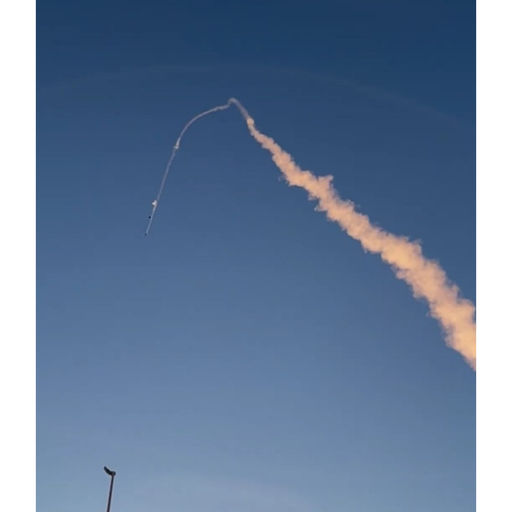
We launched UCI’s first liquid rocket (PTR) to ~9,100 ft in 2023. We rolled those lessons into our next vehicle, MOCH4—a pressure-fed MethaLOX rocket aiming to break the Collegeate Methalox Altitude Record sitting at 13,205 ft. As we redesigned the top-section aerostructures and a more robust recovery system, additive manufacturing became the force multiplier: we 3D-printed fit-check prototypes, flight-adjacent mounts and housings, assembly jigs, drill guides, cable management, purge/pack forms, and camera enclosures. Prints that used to take weeks by outsourcing now land on the bench in hours, letting us iterate on geometry, interfaces, and stiffness before we cut metal.

This is where Bambu Lab fits perfectly. High-speed, reliable printing with engineering materials (e.g., PA-CF/PC/ASA) lets us:
- Rapid-prototype top-section stringers/bulkhead interfaces and skin cutouts
- Build durable recovery fixtures (sleds, fairings, line routing, camera mounts) used in ground and solid-rocket dress rehearsals.
- Spin up tooling (jigs, templates) that compresses integration time and reduces rework.
We’re in the final push: a winter vertical test fire plus a spring flight readiness path. Partnering with Bambu means faster iteration, better data, and more flight-ready hardware—while giving students hands-on experience with modern manufacturing that they’ll carry to industry. In return, we’ll deliver clean case studies, on-hardware branding, and test/launch media showcasing how Bambu printers helped turn CAD into a 3D printed rocket-ready reality.
Previous Testing MOCH4 Media: https://drive.google.com/drive/folders/1TgtDC-UZHNRxl1PPxbx05OljhmyVSqIL?usp=sharing
Launch of our first rocket (PTR) Video: https://drive.google.com/file/d/1ot0uDkkH6FZV9489MOVNjVcPGpAnyC5L/view?usp=sharing
The Bambu Lab Experience
1) Which Bambu Lab printer(s) do you use, and why?
- Current access:
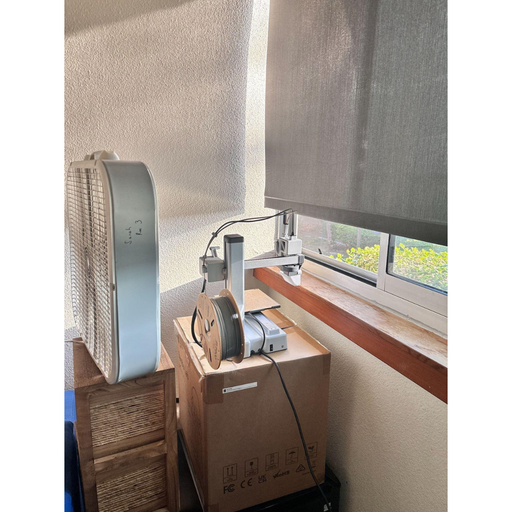
- Bambu A1 mini — set up in a member’s dorm for quick, on-call prototypes.
- Bambu P1S — hosted by a member for larger parts and faster iteration.
- MatterHackers’ Bambu X1 — via our long-standing partner, when we need higher throughput or specialty runs, or make up any shortfalls we have.
- Incoming: Brand-new H2D (donation) — this will remove our biggest bottleneck: limited on-campus availability and materials.
- Why Bambu: Speed, reliability, dimensional accuracy, and easy onboarding for new members. We moved away from tuning-heavy, early-gen printers to something that “just works,” so we can spend time engineering, not babysitting prints.
Past constraint: Relying on personal printers and partner queues led to wait times and material limitations; we couldn’t always print on our schedule or in the best engineering polymers. The H2D will close that gap.
2) What challenges/opportunities were you facing before using Bambu?
- Challenges: Machine availability, long queues, limited materials, and inconsistent print quality on older platforms.
- Impact: Slower design loops for the top-section aerostructure and avionics hardware; more rework before tests.
- Opportunity: Centralize a dependable, high-speed printer so fit checks and functional parts are same-day, not next week.
3) How has Bambu changed your workflow? Specific benefits
- Iteration speed: Hours instead of days for fit/clearance checks; faster design→test cycles.
- Material range: Practical use of PETG/ASA/PA-CF/TPU for functional parts (heat, stiffness, impact, damping).
- Quality & uptime: Better surface finish and dimensional repeatability—less sanding/rework, more plug-and-play.
- Team enablement: New members learn slicing and print hygiene quickly; fewer failures = more engineering time.
4) Critiques/areas to improve
- N/A right now. We’ll share feedback after extended H2D use (focus: high-temp polymers and repeatability during long jobs).
Application: Rapid, RF-transparent flight skins for SR-5 → MOCH4
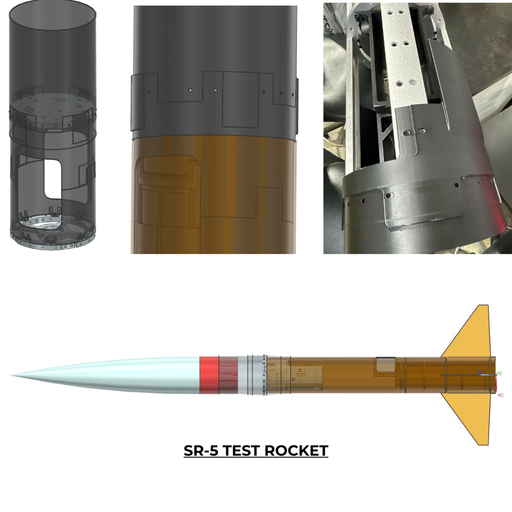
MOCH4 is our next-gen, student-built liquid methane/liquid oxygen rocket—a pressure-fed vehicle designed to be reliable, recoverable, and record-capable. To move fast without betting the whole rocket, we use SR-5, a solid-rocket testbed, as our “fly it now” platform. SR-5 lets us prototype MOCH4 subsystems that don’t depend on methalox—like the top section and avionics (AV) section skins—at full scale and in real flight environments. We 3D-print these skins, break them on the ground, fly them on SR-5, iterate, and only then lock them for MOCH4. That loop keeps risk low, learning high, and our launch schedule intact.
We’re using SR-5 (our solid-rocket flight test) to de-risk and validate the top section and avionics (AV) section for MOCH4. The approach is fast and straightforward: we 3D-print flight-like skins, beat them up on the ground, then fly them, iterate, and repeat.
Workflow
- Ground recovery tests (destructive): 3D-printed skins are bonded to composites, attached to the aerosturcure, and taken to failure with live black powder ejections testing with parachute deployment
Ground testing media ( for internal use only, do not publish): https://drive.google.com/file/d/1C2Mcs8s4-jVjUddRSQ2Ih_muF0eso5fZ/view?usp=sharing
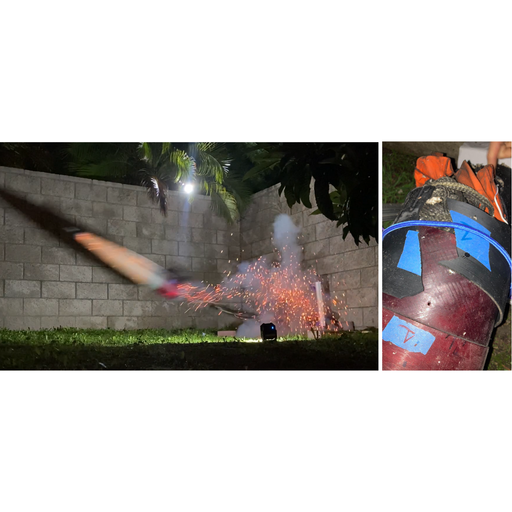
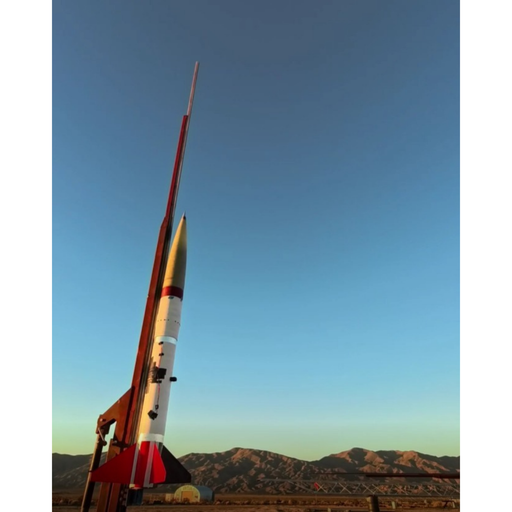
- Flight validation on SR-5: Once the skin survives ground tests, we scale to SR-5 and fly it to validate in-flight loads and recovery dynamics (drogue → main). This closes the loop on aero/thermal + shock loads you can’t perfectly simulate on the bench.
Links to Onboard Flight Footage ( for internal use only, do not publish): https://drive.google.com/file/d/1Y5ETYSlp69-RnLzbGzb4PK3PA5Fpv0TW/view?usp=sharing
Early SR-5 Launch Vehicle Video ( for internal use only, do not publish): https://drive.google.com/file/d/19FnNclfbmXZoWnGTX3E7HmYmDxmkNecG/view?usp=sharing
- Iterate & re-fly: We’re now flying additional solid rockets to tighten margins and iterate wall schemes, ribs, and inserts on the printed skins before locking MOCH4’s design.
Why 3D printing (with composite reinforcement)
- RF-transparent by design. Our top/AV sections need clean RF for cameras, telemetry, and GPS. Traditional composites (esp. CF) can attenuate RF. Printing lets us pick RF-transparent polymers, then add targeted composite reinforcement only where needed—keeping signal paths clean.
- Geometry + integration freedom. Printed skins let us integrate antenna windows, cable routes, shear-pin bosses, camera mounts, and hatches directly—no tooling churn.
- Test cadence. We can go, CAD → print → destructive test → flight in days—critical for a launch-year schedule.
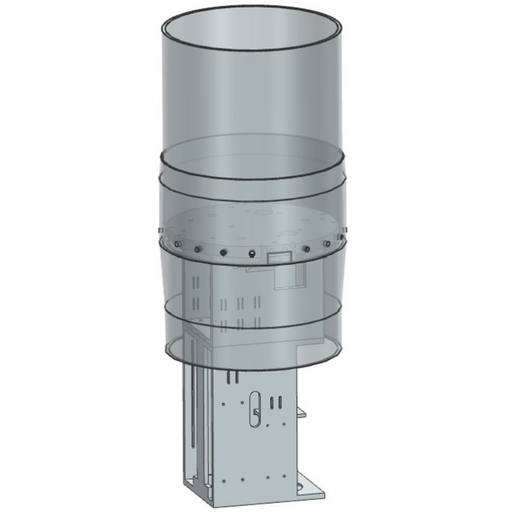
Outcome we’re driving toward:
A flight-ready, RF-transparent top/AV skin set that meets recovery loads with margin, proven first on SR-5 and then carried forward to MOCH4—with 3D printing giving us the speed to learn, the freedom to integrate, and the material palette to keep comms rock-solid.

Impact & Benefits
- Iteration speed (time-to-test): Moving skins/AV-section prototypes in-house on Bambu (vs. waiting for shop time or outsourcing) cut our loop from 5–10 days → <24 hours for most parts. That meant we could ground-test on Wednesday, reprint overnight, and fly SR-5 on the weekend.
- Cost per iteration: Outsourcing comparable prints typically ran $150–$400 each; in-house prints are ~$8–$25 of filament + machine time. That enabled destructive recovery tests without budget anxiety.
- Print reliability & quality: Compared to our older hobby printers, Bambu delivered cleaner overhangs, better dimensional consistency (critical for shear-pin bosses, camera hatches, and antenna windows), and far fewer reprints due to failed starts.
- Data-driven design: Faster cycles let us bracket designs (wall schemes, ribs, inserts) and close load/strength questions with flight data rather than relying solely on FEA—directly de-risking MOCH4.
Looking Ahead
We’ll scale 3D printing from “prototype-only” to flight-like hardware: tougher RF-transparent polymers and glass-filled nylons for AV/top skins, hybrid shells with bonded composite ribs, and embedded features (antenna windows, camera mounts, cable guides) to cut secondary ops. With the H2D on campus, we’ll be able to rapidly accelerate our testing campaign with access to higher-temp chamber/profiles for PA-GF/PA-CF, RF-oriented material testing, API/print-log export for traceability, overnight print monitoring, and back 3D-printed prototypes for hot-swappable testing.
Feedback
Bambu has been rock-solid: quick setup, sane defaults, and reliable, repeatable prints that are robust enough for flight testing—precisely what a student rocket team needs. Our long-standing partner MatterHackers has been responsive to materials and profiles. They have been critical for picking up any shortfalls in our 3D printing capabilities. Together, they’ve let us bring critical prototyping on campus without sacrificing quality or speed.

Power Your Next Build with MatterHackers
Whether you're building flight hardware, advanced prototypes, or production-ready parts, having the right printer and materials makes all the difference. MatterHackers offers a curated lineup of high-performance 3D printers and engineering-grade filaments trusted by professionals, research labs, and student teams alike. From everyday prototyping materials to carbon fiber and high-temp polymers, MatterHackers helps teams move from CAD to real-world hardware faster and with confidence. When performance, reliability, and expert support matter, MatterHackers is built to support serious innovation.
Building Something BIG? MatterHackers Supports Innovation Teams
If your team is pushing boundaries in aerospace, robotics, clean energy, or advanced manufacturing, MatterHackers wants to hear from you. We actively work with student teams, research groups, and innovation organizations through materials support, hardware guidance, and technical expertise. If you’re interested in sponsorship or partnership opportunities, send your proposal and project details to support@matterhackers.com. Our team reviews submissions to help empower the next generation of engineers, builders, and problem solvers.