
How a Maker Cut 800+ Glass Tiles for a Tiffany Lamp with a WAZER Waterjet
One of the most ambitious DIY builds imaginable. See how the WAZER Pro waterjet made a hand-assembled Tiffany lamp possible with over 800 individually cut glass tiles.

How a Maker Cut 800+ Glass Tiles for a Tiffany Lamp with a WAZER Waterjet
What does it take to build something that, at its finest, sells for millions of dollars at Christie's auction house and do it entirely by hand in your own shop?
For the YouTube maker known as Pask Makes, the answer started with a bold admission:
"I haven't worked with stained glass before and I barely know anything about it."
That honesty makes what comes next all the more impressive.
A Lamp Worth Obsessing Over
The Tiffany lamp has been an icon of American decorative art since the late 1800s, when designer Louis Comfort Tiffany began producing his now-legendary leaded glass shades in New York. Each one was built from dozens, sometimes hundreds, of small, individually shaped pieces of colored glass, cut and soldered together over a three-dimensional mold to create glowing, jewel-like scenes of nature and geometry. Original production ended around 1930. Today, surviving examples command staggering prices at auction, and Pask admits he found himself "a bit obsessed" after browsing listings on Christie's.
It's the kind of project that stops most people at the research phase. Pask started building.
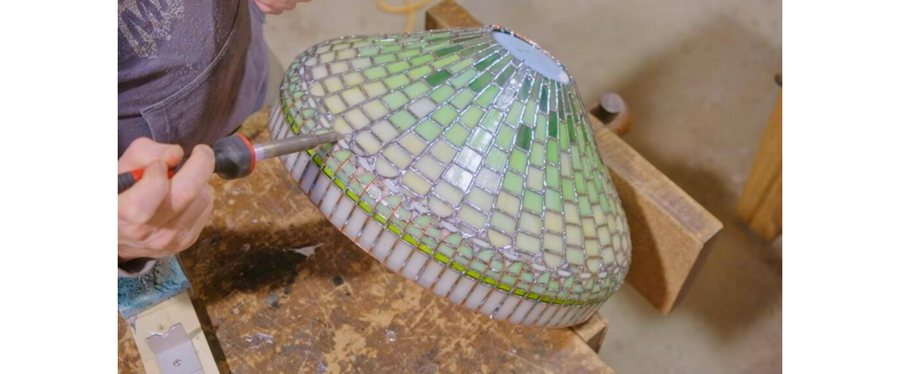
820 Pieces. One Mold. No Prior Experience.
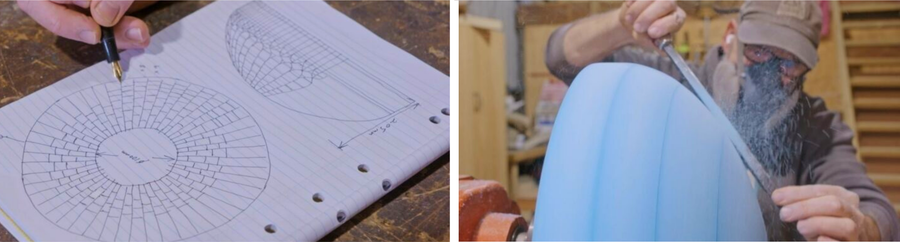
The first challenge was the design. Rather than replicating a floral Tiffany pattern, Pask was drawn to the geometric variants — structured, repeating, and still achingly complex. He acknowledged upfront that "they're all made up of a crazy amount of tiny pieces of glass," and that turned out to be an understatement.
To get started, he shaped a foam mold on the lathe and coated it in plaster, both to prevent heat damage during soldering and to give himself a stable surface for laying out the design. From there, he transferred the pattern to paper, refined the tile shapes for repeatability, and counted his pieces.
The final tally: approximately 820 individual glass tiles.
Every single one would need to be cut, edge-ground, wrapped in copper foil, and soldered into place. On a curved surface. By hand.
The Honest Reality of Hand Cutting Glass
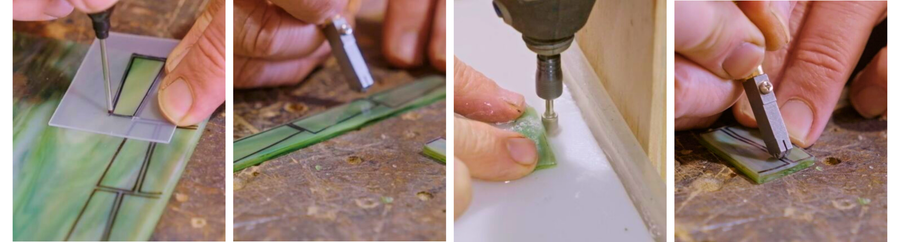
To understand why what happened next matters, you need to appreciate just how labor-intensive traditional stained glass cutting actually is.
In a conventional workflow, each piece is scored with a glass cutter, snapped along the score, refined on a wet grinder until it fits the pattern, and adjusted repeatedly. It's meditative work and slow work. Pask built his own water-cooled grinding setup using a rotary tool and a diamond bit to get a feel for the process. It worked. But as he noted plainly: "although it works well, I wouldn't say that it's a quick process."
Multiply that process by 820. The math gets discouraging fast.
At some point during early production, Pask did exactly that math, and made a decision that changed the trajectory of the entire project.
Enter the WAZER Pro: The Desktop Waterjet That Changed Everything
Faced with the prospect of weeks of repetitive hand-cutting, Pask turned to the WAZER Pro waterjet, available through MatterHackers, to take over the production cutting phase.
If you're not familiar with what a desktop waterjet can do, this project is a perfect illustration. The WAZER Pro cuts using a high-pressure stream of water mixed with an abrasive capable of slicing through metal, stone, ceramic, and yes, glass, with precision that's simply not achievable by hand at volume.
Pask scanned his hand-drawn paper templates, traced them into digital cut files, and set up each tile shape as its own cut path. The digital workflow didn't erase the handmade origin of the design, it preserved it. As he put it:
"I think it's pretty cool that the digital files do come from a handmade template."
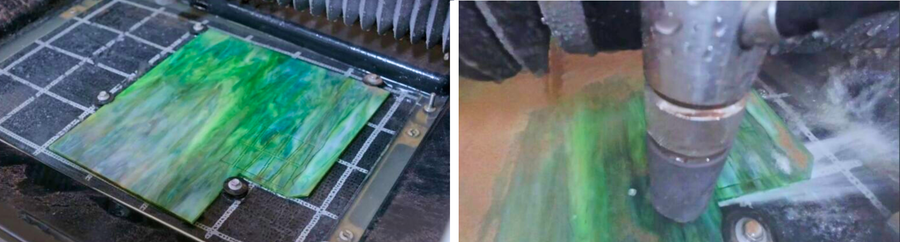
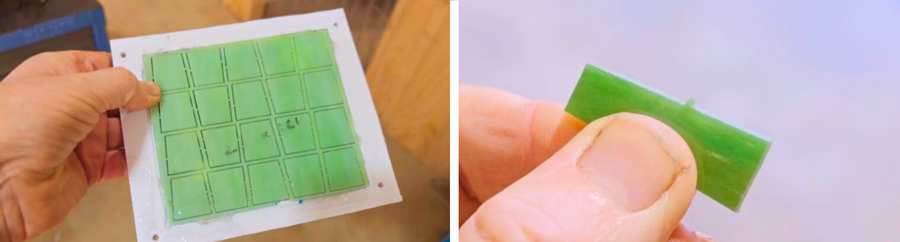
The results were immediate and measurable. Where hand-grinding each tile took significant time per piece, the WAZER Pro cut ten glass tiles in approximately three minutes. For a project requiring 820 tiles, that compression wasn't just convenient, it was the difference between a project that gets finished and one that gets abandoned.
Solving the Fixturing Puzzle
Getting fast cuts on glass isn't just a matter of pointing a waterjet at a sheet and pressing go. Glass is brittle, and as more material is removed during cutting, the remaining piece becomes increasingly fragile and prone to cracking.
Pask approached this methodically, experimenting with standoffs and sacrificial layers before landing on a method that worked: hot-gluing the glass sheet to corrugated plastic (corflute), which secured the material to the cutting bed without introducing stress into the glass itself. It's exactly the kind of iterative problem-solving that makes the WAZER so well-suited to creative and unconventional shops, the machine is approachable enough that you can experiment, iterate, and refine your process without needing a machinist's background to do it.
Not Just Glass, The Brass Gallery, Too
The glass tiles weren't the only part that benefited from the WAZER Pro.
Every Tiffany-style lamp requires a structural brass gallery — the decorative metal ring at the top of the shade that supports the glass and provides a finished edge. Rather than sourcing a generic purchased part, Pask cut his from 1mm brass sheet using the WAZER, then shaped it using custom wooden forming dies. He remarked simply:
"WAZER did a great job again."
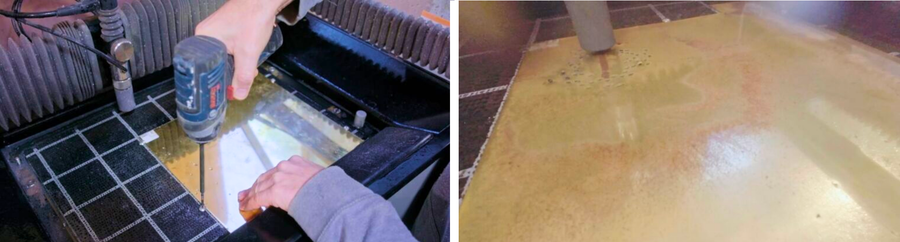
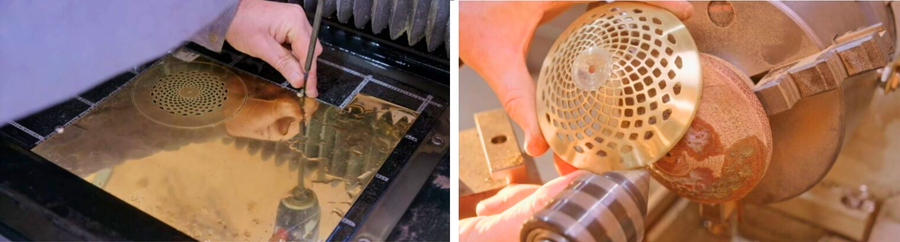
Cutting the gallery in-house meant the fit was exact, the dimensions were fully controlled, and the finished lamp remained entirely original, a detail that matters a great deal to makers who care about authenticity and craft.
What the Numbers Actually Mean
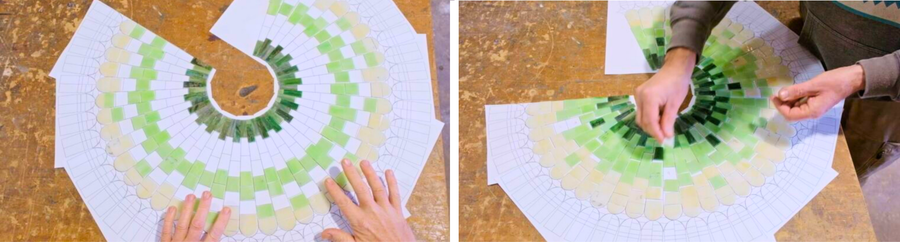
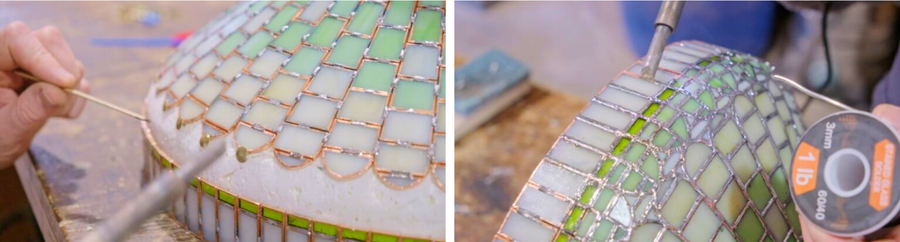
By the time Pask reached the soldering phase, the cumulative scale of the project was impossible to ignore. Even after cutting was dramatically accelerated, he estimates it still took five to six full days just to wrap every tile in copper foil before a single solder joint was made. Design revisions, adjusting tile sizes, reworking sections of the mold, added more time. Small dimensional decisions, when repeated across 820 tiles, compound quickly.
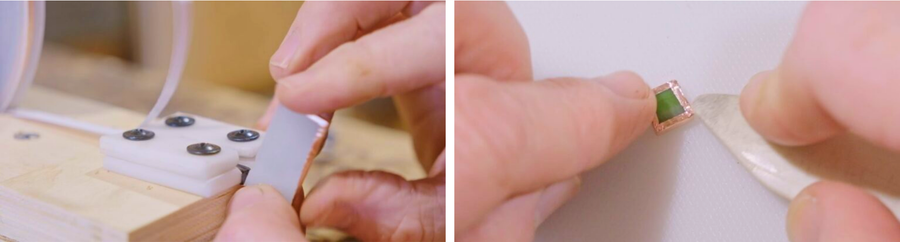
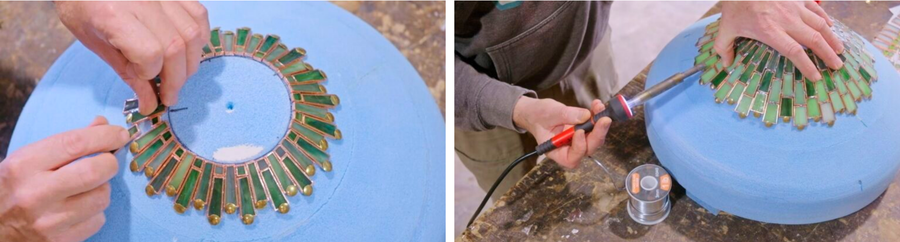
But here's the key point: those remaining labor-intensive stages are irreducibly human. The copper foiling requires hands and patience. The soldering requires skill and judgment. What the WAZER Pro eliminated was the stage that didn't need to be slow — the mechanical repetition of cutting the same tile shape, over and over, to a consistent dimension.
Pask estimates that without the waterjet, the project would have taken five or six additional weeks to complete. That's not a rounding error. That's the difference between a project that gets done and one that loses momentum halfway through and sits unfinished on a shelf.
What This Build Proves
This project is a remarkable demonstration of what becomes possible when the right tool enters a creative workflow at the right moment.
Pask Makes didn't set out to build a WAZER showcase. He set out to build a Tiffany lamp, something he'd never attempted, in a material he'd never worked with. The WAZER Pro, available through MatterHackers, simply made the scope of his ambition achievable within the reality of his schedule.
That's exactly what we think desktop waterjet cutting is for. Not to replace craft, but to clear the way for it.
If you're working on a project where the cutting is standing between you and the part you're actually trying to build, we'd encourage you to take a closer look at what the WAZER lineup can do. Whether you're cutting glass, metal, ceramic, stone, or composites, there's a machine at MatterHackers ready to handle the repetitive precision work so you can focus on what only you can do.
Explore WAZER waterjet machines at MatterHackers →
Project by Pask Makes. Originally featured on WAZER.com. Rewritten for MatterHackers.