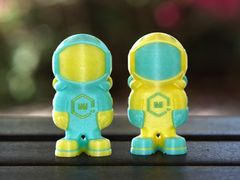
Bambu Lab Bambu Lab Absolute Black PLA Pure Filament Refill 10 Pack - 1.75mm (1kg)


Bambu Lab PLA Pure redefines what a safe PLA filament can be. Formulated with just five ingredients, each individually certified to EU food-contact standards and tested to UL GREENGUARD (UL 2904) for indoor air quality, it's the first filament of its kind. Whether you're 3D printing in a home studio, classroom, or shared workspace, PLA Pure gives you confidence that what you're 3D printing with is as responsible as what you create.
- The cleaner, safer PLA filament for homes, classrooms, and family workshops.
- Only five ingredients, every one individually certified to EU food-contact safety standards.
- A first in the filament category.
- UL GREENGUARD certified (UL 2904) for low indoor emissions, keeping particles and VOCs below recognized safety thresholds.
- Certified to EU toy-safety standards (EN 71), so the prints kids handle meet real safety benchmarks.
- Precise 1.75mm diameter with a ±0.03mm tolerance for consistent, reliable extrusion.
- Compatible with all AMS Series systems for seamless multi-material workflows.
- Ingredient-level food-contact testing goes beyond typical spool-level certifications.
Bambu Lab PLA Pure
Printing with Intention
Bambu Lab PLA Pure is a specially formulated PLA filament designed for makers who need tested, documented safety for food contact and toy applications. Unlike standard PLA, PLA Pure is composed of just five ingredients with pigments that meet EU food contact requirements, making it a responsible choice for projects like cookie cutters, measuring spoons, children's toys, and educational 3D prints. Available in five colors, each on a 1 kg spool, it delivers the easy 3D printing and fine detail PLA is known for, with the added confidence of proper test documentation.
Key Features of the Bambu Lab PLA Pure:
- Tested and documented for EU food contact compliance, ideal for cookie cutters, measuring spoons, and kitchen accessories.
- Meets toy material testing requirements, making it a safe choice for children's toys and play parts.
- Simple five-ingredient formulation with EU-compliant pigments for peace of mind.
- Retains all the best qualities of PLA: easy to 3D print, excellent detail, and low warping tendency.
Perfectly Pure Prints
PLA Pure sets itself apart from standard PLA filaments with formal testing for both food contact and toy material compliance. Bambu Lab has had the material verified against EU food contact requirements (EN 71), giving you documented confidence when 3D printing items that may touch food or be held in children's hands.
- EU food contact requirements met by pigments and formulation.
- Toy material testing documentation available.
- Only five ingredients in the filament composition.
- Every ingredient individually EU food-contact certified, not just the finished spool.
- Safe for 3D prints that kids touch, hold, and play with.


Designed for Your Everyday
From cookie cutters and measuring spoons to snack holders and kitchen organizers, PLA Pure is purpose-built for 3D prints that live in and around the home. Its consciously chosen ingredients make it a smarter material choice for household items with limited food contact, without sacrificing printability or aesthetics.
- Great for cookie cutters, measuring spoons, and food-adjacent accessories.
- Suitable for holders for packaged snacks and food items.
- Works for decorative home prints where material quality matters.
- Ideal for schools, family workshops, and child-focused maker projects.
Same Reliable Performance
PLA Pure builds on the proven strengths of PLA, one of the most popular and beginner-friendly 3D printing materials available. It 3D prints cleanly, produces sharp detail, and retains its shape, so you can focus on your project. Whether you're 3D printing for school or for the kitchen, PLA Pure delivers consistent, high-quality results.
- Low warping for reliable, consistent 3D prints.
- Excellent surface detail for functional and decorative parts.
- Compatible with standard FDM 3D printers.
- Particles and VOCs measured and confirmed below safety thresholds.
- Designed with shared and enclosed indoor spaces in mind.

Compared to Bambu PLA
| Project | Bambu PLA Basic | Bambu PLA Pure |
| Strength (Bending Strength - XY) | 76 MPa | 75 MPa |
| Bending Modulus (XY) | 2750 MPa | 2880 MPa |
| Toughness (Impact Strength - XY) | 26.6 kJ/m² | 20.6 kJ/m² |
| Bending Strength (Z) | 59 MPa | 55 MPa |
| Bending Modulus (Z) | 2370 MPa | 2599 MPa |
| Layer adhesion (Impact Strength - Z) | 13.8 kJ/m² | 10.0 kJ/m² |
Please note: To follow EU 10/2011 guidelines, some performance additives are left out. PLA Pure prints at a slightly lower setting than Bambu PLA Basic.
Hex Codes
| Pure White | #FFFFFF |
| Absolute Black | #000000 |
| Baby Blue | #A4DBE8 |
| Milky Pink | #F7CED7 |
| Apricot | #FFB673 |
Technical Specification
Recommended Printing Settings
| Subject | Data |
|---|---|
| Drying Settings Before Printing | Blast drying oven: 50 °C, 8 h X1, P and H2 Series printer heatbed: 60–70 °C, 12 h AMS 2 Pro and AMS HT: Filament inserted: 45 °C, 12 h; filament not inserted: 55 °C, 8 h |
| Recommended Re-drying Interval* | 18 days |
| Printer Compatibility | All Bambu 3D printers |
| AMS Compatibility | AMS, AMS 2 Pro, AMS HT, AMS Lite |
| Printing and Storage Container Humidity | < 20% RH (sealed, with desiccant) |
| Nozzle Size | 0.2, 0.4, 0.6, 0.8 mm |
| Nozzle Temperature | 190–230 °C |
| Build Plate Type | Textured PEI Plate / Smooth PEI Plate / Cool Plate SuperTack |
| Bed Temperature | 35–65 °C |
| Cooling Fan | Turn on |
| Printing Speed | < 200 mm/s |
| Retraction Length | 0.4–0.8 mm |
| Retraction Speed | 20–40 mm/s |
| Chamber Temperature | 25–40 °C |
| Maximum Overhang Angle | 55° |
| Maximum Bridging Length | 30 mm |
| Support | Support for PLA |
| Glue | Not recommended. Adhesive residue may compromise the contact safety of finished parts. Bed adhesion can instead be improved by increasing the bed temperature. |
*Maximum exposure time in ambient air before noticeable print-quality degradation. Full re-drying is recommended after this period. The actual interval may vary with storage temperature and humidity.
Physical Properties
| Subject | Testing Method / Conditions | Data |
|---|---|---|
| Density | ISO 1183 | 1.24 g/cm³ |
| Melt Index | 210 °C, 2.16 kg | 11.76 ± 1.6 g/10 min |
| Saturated Water Absorption Rate | 25 °C, 55% RH | 0.28% |
| Moisture Absorption Test | 25–30 °C, 55–70% RH | Approximately 0.45% maximum shown over 16 days |
Thermal Properties
| Subject | Testing Method | Data |
|---|---|---|
| Melting Temperature | DSC, 10 °C/min | 160 °C |
| Glass Transition Temperature | DSC, 10 °C/min | 55 °C |
| Crystallization Temperature | DSC, 10 °C/min | Not specified |
| Vicat Softening Temperature | ISO 306, GB/T 1633 | 63 °C |
| Heat Deflection Temperature | ISO 75, 1.8 MPa | 56 °C |
| Heat Deflection Temperature | ISO 75, 0.45 MPa | 60 °C |
Mechanical Properties
| Subject | Testing Method | Data |
|---|---|---|
| Young's Modulus (X-Y) | ISO 527, GB/T 1040 | 2481 ± 20 MPa |
| Young's Modulus (Z) | ISO 527, GB/T 1040 | 2196 ± 25 MPa |
| Tensile Strength (X-Y) | ISO 527, GB/T 1040 | 51.5 ± 2 MPa |
| Tensile Strength (Z) | ISO 527, GB/T 1040 | 30.0 ± 3 MPa |
| Breaking Elongation Rate (X-Y) | ISO 527, GB/T 1040 | 5.6 ± 1.0% |
| Breaking Elongation Rate (Z) | ISO 527, GB/T 1040 | 2.8 ± 0.5% |
| Bending Modulus (X-Y) | ISO 178, GB/T 9341 | 2880 ± 100 MPa |
| Bending Modulus (Z) | ISO 178, GB/T 9341 | 2599 ± 71 MPa |
| Bending Strength (X-Y) | ISO 178, GB/T 9341 | 75 ± 2 MPa |
| Bending Strength (Z) | ISO 178, GB/T 9341 | 55 ± 5 MPa |
| Impact Strength (X-Y) | ISO 179, GB/T 1043 | 20.6 ± 0.7 kJ/m² |
| Impact Strength (Z) | ISO 179, GB/T 1043 | 10.0 ± 0.7 kJ/m² |
Mechanical Test Conditions
| Material | PLA Pure Milky Pink |
| Pre-drying | 50 °C blast drying oven for 8 hours |
| Printer | Bambu H2D |
| Nozzle | 0.4 mm hardened steel nozzle |
| Nozzle Temperature | 220 °C |
| Bed Temperature | 55 °C |
| Printing Speed | 147 mm/s |
| Infill | 100% |
| Recommended Annealing | 50–60 °C for 6–12 hours |
| Annealing Precautions | Results depend on temperature, holding time, model size, structural complexity, and infill. Use equipment with uniform temperature distribution and keep the material or model tray away from the heat source. Do not use a microwave or kitchen oven. |
Other Physical and Chemical Properties
| Subject | Data |
|---|---|
| Color and State | Red, white; solid |
| Odor | Odorless |
| Composition | Polylactic acid |
| Skin Hazards | No hazard |
| Chemical Stability | Stable under normal storage and handling conditions |
| Solubility | Insoluble in water |
| Resistance to Acid | Not resistant |
| Resistance to Alkali | Not resistant |
| Resistance to Organic Solvents | Not resistant to some organic solvents |
| Resistance to Oil and Grease | Resistant to most kinds of oil and grease |
| Flammability | Flammable |
| Combustion Products | Water and carbon oxides |
| Odor of Combustion Products | Odorless |
Mechanical Properties Comparison
| Property | PLA Basic | PLA Matte | PLA Pure | PLA Silk+ | PLA Lite | PLA Tough+ |
|---|---|---|---|---|---|---|
| Density | 1.26 | 1.32 | 1.24 | 1.27 | 1.4 | 1.21 |
| Bending Modulus (X-Y) | 69.6 ± 2 | 55.5 ± 1 | 75 ± 2 | 76.3 ± 2 | 53.4 ± 3 | 63 ± 1 |
| Bending Strength (X-Y) | 2935.2 ± 100 | 2280.2 ± 50 | 2880 ± 100 | 2316.2 ± 100 | 2622.1 ± 100 | 2123.1 ± 50 |
| Impact Strength (X-Y, Un-notched) | 19 ± 1.5 | 27.35 ± 4 | 20.6 ± 0.7 | 12 ± 3 | 18.95 ± 1.5 | 109.4 ± 20 |
| Bending Strength (Z) | 54 ± 1.5 | 37.6 ± 1 | 55 ± 5 | 29.6 ± 2 | 25.1 ± 2 | 48.7 ± 1 |
| Bending Modulus (Z) | 2597.9 ± 100 | 1843.8 ± 100 | 2599 ± 71 | 1993.6 ± 100 | 2069.8 ± 100 | 1883.2 ± 100 |
| Impact Strength (Z, Un-notched) | 12.8 ± 2 | 11.78 ± 2.5 | 10 ± 0.7 | 4.3 ± 1 | 5.45 ± 2 | 31.18 ± 10 |
Additional Information
- TDS of Bambu PLA Pure
- Safety Data Sheets
- Filament RoHS
- Bambu Lab Filament Hex Code Table
- EU Food Contact Report
- EN Toy Safety Report
Tips and Tricks
- Food-contact certification applies to the filament itself. Producing food-contact-safe 3D printed parts depends on equipment hygiene (particularly the nozzle), printing environment, and other factors.
- Due to layer lines, 3D printed parts are not suitable for holding liquid foods. Because of PLA's properties, do not expose 3D printed parts to temperatures above 60°C. For detailed guidance, see the PLA Pure Advanced Printing Guide on the Bambu Lab Wiki.
- Bambu PLA Pure is specifically developed for FDM 3D printing with both emission safety and contact safety in mind. When used with its default profile, it delivers excellent print quality and supports contact-safe performance. Because real-world use can vary across environments, conditions, and workflows, applications requiring a higher level of contact safety should follow additional guidance.
- Compatible with all 3D printers, AMS, build plate, and nozzles.
- For contact-safe finished parts, the use of adhesive is not recommended.
- Enhanced bed adhesion can alternatively be achieved by increasing the bed temperature.
- Dry before use to ensure the best 3D print quality and consistent finish. Store in a dry environment after use.
- The refill filament needs to be used with a spool. For detailed instructions on how to swap in the new filament using a Reusable Spool, please refer to our article: How to Refill Filament on MatterHackers Reusable Spools.
*Please Note
- Although this product has passed food-contact compliance testing at both the raw material and printed sample level, 3D printing is a multi-variable process. The quality and safety of finished 3D prints depend on factors such as equipment, printing environment, operating procedures, and post-processing.
- There is no guarantee that such user-produced 3D prints will meet applicable food-contact regulations, standards, or certification requirements in any jurisdiction.