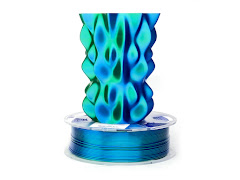
Protopasta Protopasta Nice 'N Navy Opaque HTPLA - 1.75mm (0.5kg)


Protopasta's Gloop! Themed HTPLA Filament is a vibrant collaboration between Protopasta and Gloop! This exclusive collection combines the ease of PLA 3D printing with the enhanced durability of heat-treated HTPLA, offering an exciting palette inspired by both the serious and whimsical sides of 3D printing. From classic solids to playful translucents, these filaments bring a splash of creativity to every project.
- Prints easily like PLA without the need for a hardened nozzle.
- Explore a color palette ranging from cool and classy to whimsical and eye-catching.
- Easily heat-treat your 3D parts post-printing at 100-120°C (200-250°F) to achieve up to three times the thermal stability of standard PLA.
To learn about available discounts, training, and maintenance options, please use the form below and a MatterHackers Expert will contact you within one business day. Alternatively, you can always feel free to give us a call at +1 (800) 613-4290 or email sales@matterhackers.com.
To get an instant quote, add everything you need to your cart, and click "Download as quote".
Protopasta Gloop! Themed HTPLA Filament
An Artistic Collaboration of Science
Explore the dynamic world of Protopasta's Gloop! Themed HTPLA Filament, where vibrant colors meet superior functionality. This collection, born from a creative collaboration with Gloop!, offers a unique blend of classic and playful hues, designed to inspire and perform. Whether you're aiming for artistic expression or robust functionality, these filaments deliver on all fronts.
Key Features of the Protopasta Gloop! Themed HTPLA Filament:
- Developed with the innovative minds at Protopasta and Gloop!, this collection captures the essence of creative exploration and technical excellence.
- Benefit from heat-treating capabilities that provide increased durability and performance at higher temperatures.
- Proudly manufactured in the USA, this exclusive filament guarantees superior quality and reliability.
- Designed to work with a variety of 3D printers, this filament adjusts to different hardware setups for optimal 3D printing outcomes.
Cool and Classy
Discover Protopasta Gloop! Themed HTPLA Filament, where bold and beautiful colors meet the durability of heat-treated HTPLA. This exclusive collection combines the ease of PLA printing with enhanced temperature resistance, making it ideal for both aesthetic and functional 3D projects.
- Lab Coat White is a cool white that features a touch of violet to prevent yellowing, ensuring your prints remain crisp and clean.
- Nice ‘n Navy Blue is a sophisticated navy that borders on black. This color adds a level of class and complexity to any 3D print.
- Caution Opaque Yellow is a bold and striking shade that commands attention, much like the industrial robots it emulates.


Dazzling Translucents
Enjoy enchanting translucent colors that are not just visually stunning, but bring a magical touch to your 3D prints with their unique ability to sparkle and glow. This collection transforms your 3D prints into luminous works of art that captivate and inspire.
- Perfect for 3D prints that demand a touch of whimsy and elegance.
- Gloop! Purple is a captivating translucent purple infused with sparkles, adding a playful yet sophisticated flair to your 3D prints.
- Under a blacklight, Ecto Ooze Green comes to life, making it ideal for prints that need to stand out both day and night.
Strength and Stability
Protopasta's HTPLA is an advanced form of PLA designed to withstand higher temperatures through a process called heat treating (or annealing). Unlike standard PLA, HTPLA can be transformed from an amorphous structure to a crystalline one, enhancing its thermal resistance and durability.
- Heat treating significantly boosts the temperature resistance of your 3D prints, ensuring they maintain their integrity in higher-temperature environments.
- By baking your 3D printed parts post-production, you convert the filament's structure from amorphous to crystalline, locking in durability and performance.
- Annealing enhances machinability and formability, increases ductility and toughness, and provides stress relief to your 3D-printed parts.

Ideal for Advanced Applications

- Heat treating HTPLA changes its internal structure, allowing it to maintain its properties well above the glass transition temperature (Tg) and up towards the melting point (Tm).
- The shift from an amorphous to a crystalline structure means that HTPLA retains its strength and functionality even in higher temperature environments, making it ideal for more demanding applications.
- This transformation significantly broadens the useful temperature range of HTPLA, as demonstrated by the difference between Tg and Tm in differential scanning calorimetry (DSC) results.
- With its enhanced properties, HTPLA is perfect for 3D projects requiring higher thermal stability without sacrificing the ease of use associated with standard PLA.
How to Anneal HTPLA
To fully capitalize on the benefits of HTPLA, heat treating (or annealing) is essential post-printing, as the crystalline structure reverts to amorphous when melted. Follow these improved step-by-step instructions to enhance your 3D prints:
Gather Your Materials:
- A large oven with precise temperature control and stability.
- Aluminum foil, if you have a small oven or one with glowing coils, to shield the 3D prints from direct heat.
- A flat surface, such as a wood block, cutting board, or silicone mat, is placed on a baking sheet.
- Your HTPLA 3D printed parts, with supports if necessary.
Prep Your Oven:
- Preheat the oven to a temperature range of 95-120°C (200-250°F).
- If using an electric oven, wait until the coils are no longer glowing. If glowing coils are unavoidable, cover them with the foil sheet to prevent direct heat exposure before preheating your oven.
Bake Your 3D Prints:
- Once the oven is preheated, carefully place your 3D printed part on the prepared surface and insert it into the oven.
- Bake the part for approximately 10 minutes. Or until you observe a change in the material's appearance, indicating the transformation to a crystalline structure.
Technical Specifications
Material Properties
| Properties | Value/Description |
| Base Material | Heat treatable PLA w/ high temp resistance |
| Characteristics | Low odor, non-toxic, renewably sourced |
| Molecular Structure |
Amorphous or partially crystalline
|
| Max particle size | 0.1 mm (may limit resolution) |
| Density | Approximately 1.24 g/cc |
| Length | Approximately 346 m/kg (1.75 mm) & 130 m/kg (2.85 mm) |
| Min Bend Diameter | 15 mm (1.75 mm) & 40 mm (2.85 mm) |
| Glass Transition (Tg) Onset |
Approximately 60°C (140°F) |
| Melt Point (Tm) Onset | Approximately 155°C (310°F) |
| Max Use |
|
Print Settings
| Nozzle Temperature [°C] | 206 |
| Heated Bed Temperature [°C] | 60 |
| Print Speed [mm/s] | 25-45 |
| Flow Rate/Extrusion Multiplier [%] | 100 |
| Extrusion Width [mm] | .45 (.05mm larger than nozzle size) |
| Volume Flow Rate [mm³/s] | 2-3 |
Heat Treating
| Part Axis | Percentage |
| Scale Values (x/y-axis) | 102.2% |
| Scale Values (z-axis) | 99% |
| Typical Heat Treat Temperature | Typical Heat Treat Time |
| 95-110°C | Approximately 10 minutes |
Tips & Tricks
- HTPLA doesn't require drying, but if drying, do not dry above the glass transition temperature, as this can heat treat HTPLA. For PLA, dry at 50°C (125°F).
- Use a 0.4 mm brass or plated brass nozzle with a heater block sock at a temperature of 195 - 225 °C and a bed temperature of 50 - 56°C.
- Ensure your 3D print bed is clean with adhesive.