
Comparison Guide: Which Bambu Lab 3D Printer is Right for Me?
Discover which Bambu Lab 3D printer fits your needs—compare features, benefits, and find your perfect match in our in-depth lineup guide!

Bambu Lab's Lineup Just Got a Lot More Interesting
A year ago, picking a Bambu Lab printer was straightforward. Today, the lineup spans nine machines across three distinct families, and the differences between them matter more than ever. Whether you've never touched a 3D printer or you're managing a fleet of them, this guide will cut through the noise and get you to the right machine. We'll cover every current model, call out the ones being sunset, and tell you exactly what each printer is, and isn't built for.
TABLE OF CONTENTS
- Who Is This Guide For?
- The A1 Series
- The P Series
- The X Series
- The H2 Series
- Head-to-Head Comparisons
- Conclusion
- Tech Specs Reference
Who Is This Guide For?
Before diving into specs, it helps to know which type of buyer you are. Bambu's lineup is built in tiers, and each one has a clear target. Find yourself below, then jump straight to that section.
The Curious Starter
You're new to 3D printing, or buying your first Bambu. You want something that works out of the box without a learning curve. You're not planning to print engineering polymers (yet!), and that's completely fine.
Start with the A1 Series.
The Hobbyist Upgrader
This isn't your first rodeo. You're comfortable printing with PLA, PETG/PCTG, and maybe ABS/ASA. You want faster speeds, better materials, and multi-color or multi-material capability, but without H2 level investment.
The P Series or X Series are your tiers.
The Maker / Prosumer
You print functional parts, and need a machine that won't hold you back. You've thought about, or tried PA variants and CF/GF composites, but the workflow hasn't been easy. You see the benefit in dual extrusion, a large build volume, and the option to do more than just print.
The H2 Series was built for you.
The Professional / Enterprise Buyer
Uptime, repeatability, and network security aren't afterthoughts, they're requirements. You may already have Bambu machines in your shop and are evaluating what the current lineup offers for your environment.
The H2D Pro is worth your time.
The A1 Series
The A1 family is where most people start with Bambu, and for good reason. Both machines are open-frame (no enclosure), fast to set up, and genuinely plug-and-play. They're purpose-built for the materials most people actually print with, delivered at a price that doesn't require justification.
Bambu Lab A1 Mini (Released: September 2023)
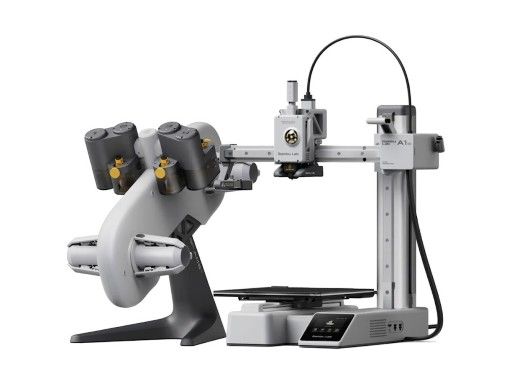
The A1 Mini is the smallest machine in the lineup and, for a lot of people, the right one. Its 180 × 180 × 180mm build volume is genuinely small. Think miniatures, phone stands, cosplay accessories, and small functional parts. But within that footprint it delivers clean, reliable results. Auto bed leveling, a responsive 3.5" touchscreen, and the option to add the AMS Lite for up to four colors make it far more capable than its price tag suggests.
What it won't do: it doesn't have an enclosure, so materials that need a controlled environment like ABS, ASA, and PA aren't in its wheelhouse. Stainless steel nozzle and extruder gears are the baseline here, not hardened steel, which means composite filaments like carbon fiber aren't recommended without an upgrade. If your projects fit in a 7" cube and live in the PLA/PETG/TPU world, the Mini is a smart, no-regrets buy.
Bambu Lab A1 (Released: December 2023)
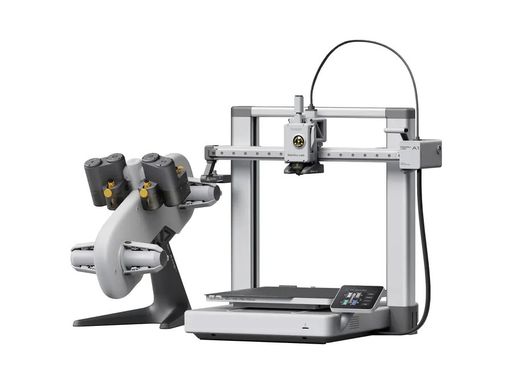
The A1 takes everything the Mini does well and gives it room to breathe. The build volume jumps to 256 × 256 × 256mm (roughly a 10" cube), which opens up the kinds of projects where you actually feel constrained on the Mini. The bed temperature steps up to 100°C (vs 80°C on the Mini), giving you a bit more flexibility with materials like PETG and TPU. It supports up to four AMS units for multi-color printing, and the larger touchscreen makes navigating the interface easier.
Like the Mini, it's open-frame, so the enclosure crowd will want to look further up the lineup. But for a beginner who wants to grow into the machine, or a casual maker who just wants reliable, quality prints without the fuss, the A1 is the sweet spot. It's the printer we'd buy for a teenager's bedroom, a classroom, or a first home workshop and not feel like we made a compromise doing it.
The P Series
The P Series is Bambu's enclosed workhorse family. Fully enclosed chambers, hardened steel toolheads, and support for the full range of engineering-grade materials. This is where makers who've outgrown the A1 land, and where print farms and small studios have been running for years. The P2S is the current machine. The P1S is its legendary predecessor, still available while stock lasts.
Bambu Lab P2S (Released: October 2025)
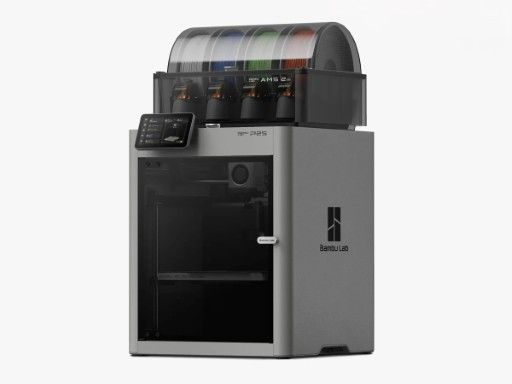
The P2S is the direct evolution of the P1S, one of the best-selling 3D printers of all time, and it earns that lineage. What changed: a new 5" full-color touchscreen replaces the old button interface, the DynaSense extruder brings filament grinding detection and tighter extrusion control, Active Airflow cooling improves bridging and overhangs, and AI-powered error detection catches problems before they waste a full print. It also gets a high-rate 1080p camera for real-time monitoring and a better-designed UI that's noticeably faster to navigate.
What stayed the same: fully enclosed chamber, hardened steel nozzle and extruder gears, 256 × 256 × 256mm build volume, and the passive chamber heating that makes it solid for ABS and ASA. The P2S hits a price-to-capability ratio that's hard to argue with. It supports up to 24 filaments with multiple AMS 2 Pro units, covers the full range of standard and engineering-grade materials, and runs on Bambu's current-generation platform with software support through 2030. This is the workhorse. If you want an enclosed, single-nozzle printer that handles everything from PLA to carbon fiber without drama, this is it.
Bambu Lab P1S (Released: June 2023) — Legacy
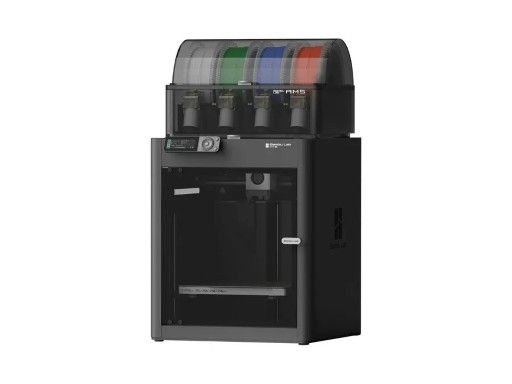
The P1S spent two years as the default recommendation for anyone who wanted reliable, enclosed, multi-material printing at a reasonable price. It built print farms, supplied small businesses, and did it all with a 256mm build volume and support for ABS through carbon fiber composites. The P2S supersedes it on virtually every front, but the P1S remains available at a reduced price while stock lasts. If budget is the deciding factor and the older button interface doesn't bother you, it's still a proven machine. Software support through July 2028.
The X Series
The X Series is Bambu's compact enclosed platform for makers who want more capability without stepping up to H2 scale and price. The X2D is the current machine, bringing dual-nozzle printing to the lineup at an accessible price point for the first time. The X1C and X1E have been officially discontinued but remain available as refurbished units.
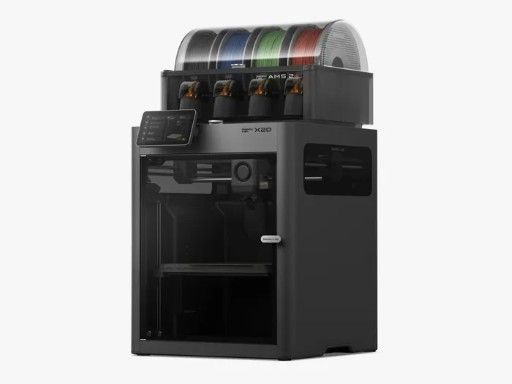
Bambu Lab X2D (Released: April 2026)
The X2D is the newest machine in the lineup, and it fills a gap that's existed since Bambu launched. For the first time, dual-nozzle printing is available in a compact, X-series footprint at a price that doesn't require a business case. The X2D is fully enclosed, actively heated to 65°C, and ships with the full suite of H2-era sensors and monitoring, including a toolhead camera for AI print oversight. It keeps roughly the same 256 × 256mm build area as the P2S, so it fits on the same desk.
The dual nozzle setup here is worth understanding, since it's not the same system as the H2D. Both nozzles sit on a shared toolhead, with the left nozzle running direct drive and the right running Bowden. That means the left nozzle handles your primary model material with full precision and TPU capability, while the right handles support material or a secondary color. The practical result is clean, waste-free support removal and true dual-material printing at a mainstream price. It's an ideal step up from the P2S for anyone who finds themselves wishing they could mix materials or eliminate manual support cleanup.
Bambu Lab X1 Carbon (Released: July 2022) — Legacy
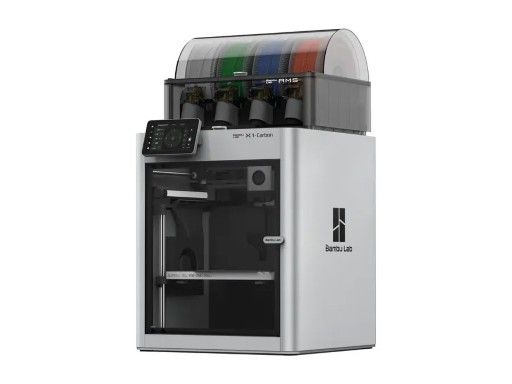
The machine that put Bambu on the map. When it launched, the X1C was the fastest, smartest enclosed desktop printer available, and it introduced Bambu's AI-powered print monitoring to the world. It still handles ABS, ASA, PA, PC, and composite filaments without issue, and with Micro LiDAR and a full 5" touchscreen, it was genuinely ahead of its time. Today, the P2S matches or exceeds it in nearly every relevant spec at a lower price, on a platform with a longer support runway. Refurbished units are available and represent solid value for anyone who wants enclosed, engineering-grade printing without paying current-generation pricing. Software support through May 2027.
Bambu Lab X1E (Released: October 2023) — Legacy
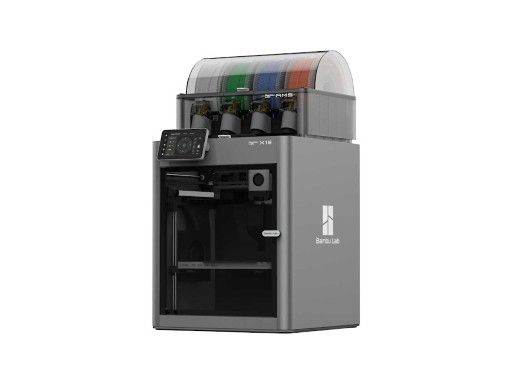
The X1E was Bambu's answer for organizations where a networked printer needed to meet IT requirements: Ethernet port, WPA2-Enterprise Wi-Fi, physical network kill switch, and a removable network module for air-gapped environments. It also added active chamber heating (60°C) and HEPA filtration over the X1C. That security feature set has since been carried forward into the H2D Pro, which adds the same protections to a far more capable platform. We no longer carry the X1E in active stock. If enterprise security is your requirement, the H2D Pro is the current answer. Software support through October 2028.
The H2 Series
The H2 family is a different category of machine entirely. Larger build volumes, active chamber heating to 65°C, 350°C nozzles, HEPA and carbon filtration, and an ecosystem of add-on modules including laser, knife cutter, and pen plotter that turns any H2 printer into a personal fabrication hub. All four H2 machines share the same platform and accessory compatibility. Where they differ is in how they handle multiple materials, and that difference is the whole decision.
A note on the H2 ecosystem: the optional 10W and 40W laser modules, cutting module, and pen plotter are compatible across the H2D, H2C, H2D Pro, and H2S (the H2S supports the 10W laser; H2D, H2C, and H2D Pro support both 10W and 40W). If multi-tool capability is part of your workflow, any H2 machine gets you there.
Bambu Lab H2S (Released: August 2025)
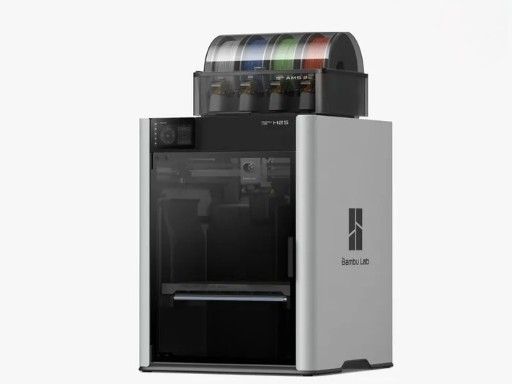
The H2S is the single-nozzle member of the H2 family. Because it doesn't need to accommodate the second nozzle's lift mechanism, it gets a larger build volume than the H2D: 340 × 320 × 340mm. Everything else is H2-platform: active chamber heating, 350°C hotend, full sensor suite, HEPA and carbon filtration, and the same accessory ecosystem. It supports the 10W laser module and the cutting and pen plotter tools. AMS compatibility means you can still run multi-color prints up to 16 filaments via the standard filament-switching purge cycle.
The H2S is for the maker who wants the H2 platform's material capability and build volume without the operational complexity of managing two nozzles and their respective temperatures, materials, and calibrations. If your workflow is primarily single-material engineering prints in PA, PC, ABS, or composites, and you want the biggest bed available with full enclosure and active heating, the H2S makes a strong case. It's also the most approachable on-ramp into the H2 ecosystem for someone upgrading from an X-series machine.
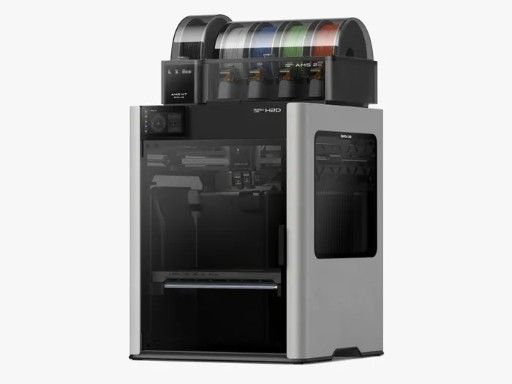
Bambu Lab H2D (Released: April 2025)
The H2D launched as Bambu's vision of a personal manufacturing hub, and it delivered. Two independent nozzles, each capable of 350°C, mean you can print rigid and flexible materials in the same job, use soluble PVA supports that wash away cleanly, or run two different engineering materials simultaneously. The build volume is 350 × 320 × 325mm, the actively heated chamber runs to 65°C, and 50μm motion accuracy via optional Vision Encoder makes it precise enough for functional, tolerance-critical parts.
The monitoring suite is extensive: BirdsEye camera, nozzle camera, toolhead camera, and 15 sensors along the filament path tracking velocity, tension, and extrusion pressure. It can connect up to 12 AMS units simultaneously, supporting up to 25 colors, and the optional laser modules open up engraving, cutting, and marking without leaving your workspace. If you're prototyping functional parts with mixed materials, running small production batches, or want a machine that earns its footprint by doing more than just print, this is where to start in the H2 family.
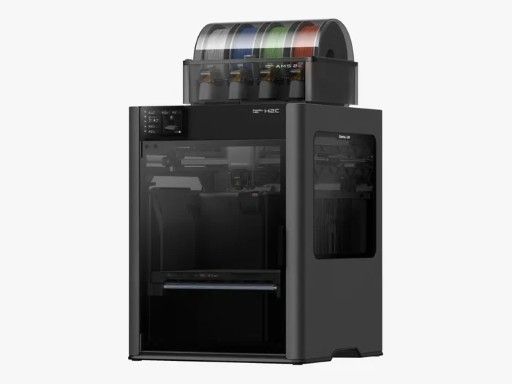
Bambu Lab H2C (Released: November 2025)
The H2C exists to solve a specific problem: filament waste during multi-color printing. Every other AMS-based printer, including the H2D, generates purge waste when switching materials because the nozzle has to flush the previous filament before the next one can print cleanly. The H2C eliminates this with Vortek, a hotend-swapping system where up to six interchangeable hotends are stored in a dock on the toolhead. Each hotend is dedicated to a specific filament. When the printer needs to switch, it swaps the entire hotend with no purging and no waste. Each hotend heats to working temperature in 8 seconds via inductive wireless power, with micrometer-level repeatability on every swap.
With six dedicated hotends plus one fixed nozzle, the H2C can print up to seven materials in a single job with zero purge waste. Combined with AMS, that expands to 24 filaments. One important distinction: the H2C is exceptional at multi-color and multi-material printing where materials are AMS-compatible. It is not the right choice if your primary need is combining materials with very different temperature requirements in a single print, like TPU alongside PA6-GF. Those pairings need two dedicated nozzles running simultaneously, which is what the H2D does. If you already own an H2D and want to upgrade, a Vortek Upgrade Kit is available, though installation is a multi-hour technical process not recommended for casual users.
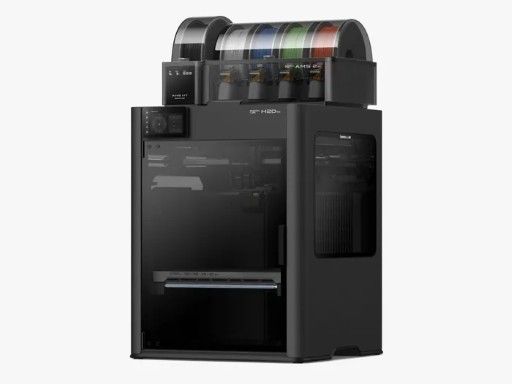
Bambu Lab H2D Pro
The H2D Pro takes the H2D's core manufacturing platform and adds the two things enterprise environments require: enterprise-grade network security and tungsten carbide nozzles for extended wear life on abrasive materials. On the security side, it ships with an Ethernet port, WPA2-Enterprise Wi-Fi with 802.1X authentication, a physical network kill switch, and a modular communication board that can be physically removed for air-gapped deployments. On the materials side, tungsten carbide nozzles rated HRA 90 hardness extend nozzle lifespan by approximately 50% compared to standard hardened steel when running abrasive composites, a meaningful operational benefit in high-volume production environments.
It also includes the Vision Encoder system as standard (optional on the base H2D), delivering 50μm motion accuracy across the full workspace. If your organization is vetting 3D printers against IT security requirements, or if you're running continuous production of engineering parts and want to reduce consumable replacement frequency, the H2D Pro is the current top of the Bambu lineup. Contact our sales team at sales@matterhackers.com for enterprise pricing and deployment options.
Head-to-Head: The Comparisons That Actually Matter
A1 Mini vs. A1
The honest answer: usually the A1 is worth it. The price gap between the two is small, and the jump from a 7" cube to a 10" cube opens up a significantly wider range of projects. The Mini makes sense if desk space is genuinely limited, if you're buying it specifically for small-scale prints like miniatures, jewelry, or prototypes, or if the lower cost is the deciding factor. For anyone else, the A1 is the better long-term buy. You won't outgrow it as quickly, and the higher bed temperature gives you a bit more material flexibility down the road.
P2S vs. X2D
This is the clearest decision in the lineup. The P2S and X2D are the same price tier, same form factor, same enclosed platform. The difference buys you a second nozzle. If multi-material printing is genuinely part of your workflow, dedicated support material, mixing rigid and flexible elements, or faster dual-color printing without AMS purge waste, the X2D is worth the step up. If you're printing single-material projects 90% of the time and adding color with AMS, the P2S is the simpler, slightly more affordable choice and it's excellent at what it does. Note that neither machine has Micro LiDAR (that feature lived in the X1C and H2 series), so if that matters to you, the H2 lineup is where to look.
H2S vs. H2D vs. H2C
All three machines share the same platform, the same material capability, and the same accessory ecosystem. The differences come down entirely to how you handle multiple materials.
Choose the H2S if you primarily print single-material jobs, even demanding ones. You want the largest possible H2 build volume. You don't need to combine different material types within a single print, and you're comfortable using AMS for multi-color work via the standard purge cycle. It's the most approachable H2 machine and the right entry point into the platform for upgraders from the P or X Series.
Choose the H2D if you need to combine two different materials in the same print simultaneously: rigid plus flexible, model plus soluble support, or two engineering-grade polymers. The fixed dual nozzle system handles material pairings that require different temperatures or chemistries running at the same time. This is the machine for functional prototyping where part design requires mixed materials, not just mixed colors.
Choose the H2C if multi-color efficiency and zero purge waste are your priorities. You run high volumes of multi-color prints and the cost of purged filament adds up. Your material switching is within AMS-compatible filaments, and you want the most automated, waste-free approach to color printing currently available on any desktop machine. It's also the right choice for small businesses and studios where print-to-print time and material cost directly affect margins.
Conclusion
Bambu Lab has moved fast, and the lineup reflects it. Nine machines across four families in four years, each one meaningfully different from the last. The A1 series remains the best entry point in desktop printing. The P Series covers the enclosed workhorse territory where most serious makers live. The X Series adds dual extrusion at a price that finally makes sense for individual buyers. And the H2 family is in a category of its own: personal manufacturing machines that happen to 3D print, laser engrave, cut, and plot from the same footprint. Pick the tier that matches your work today, and trust that whichever platform you land on has room to grow.
TECHNICAL SPECS REFERENCE
A1 Series & P Series
| Model | A1 Mini | A1 | P2S | P1S (Legacy) |
|---|---|---|---|---|
| Released | Sep 2023 | Dec 2023 | Oct 2025 | Jun 2023 |
| Build Volume (W×D×H) | 180×180×180mm | 256×256×256mm | 256×256×256mm | 256×256×256mm |
| Extrusion | Single | Single | Single | Single |
| Enclosed | No | No | Yes | Yes |
| Chamber Heating | None | None | Passive | Passive |
| Max Nozzle Temp | 300°C | 300°C | 300°C | 300°C |
| Max Bed Temp | 80°C | 100°C | 110°C | 100°C |
| Nozzle / Extruder | Stainless / Steel† | Stainless / Steel† | Hardened Steel | Stainless / Steel† |
| Air Filtration | None | None | Activated Carbon | Activated Carbon |
| Software Support Until | — | — | Oct 2030 | Jul 2028 |
X Series
| Model | X2D | X1C (Legacy) | X1E (Legacy) |
|---|---|---|---|
| Released | Apr 2026 | Jul 2022 | Oct 2023 |
| Build Volume (W×D×H) | 256×256×260mm | 256×256×256mm | 256×256×256mm |
| Extrusion | Dual | Single | Single |
| Enclosed | Yes | Yes | Yes |
| Chamber Heating | Active 65°C | Passive | Active 60°C |
| Max Nozzle Temp | 320°C | 300°C | 320°C |
| Max Bed Temp | 120°C | 120°C | 120°C |
| Nozzle / Extruder | Hardened Steel | Hardened Steel | Hardened Steel |
| Air Filtration | G3 + H12 + Carbon | Activated Carbon | G3 + H12 + Carbon |
| Bambu Micro Lidar | No | Yes | Yes |
| Enterprise Security | No | No | ✔ Full suite |
| Software Support Until | Apr 2031 | May 2027 | Oct 2028 |
H2 Series
| Model | H2S | H2D | H2C | H2D Pro |
|---|---|---|---|---|
| Released | Aug 2025 | Apr 2025 | Nov 2025 | — |
| Build Volume (W×D×H) | 340×320×340mm | 350×320×325mm | 305×320×325mm‡ | 350×320×325mm |
| Extrusion | Single | Dual | Dual + Vortek | Dual |
| Enclosed | Yes | Yes | Yes | Yes |
| Chamber Heating | Active 65°C | Active 65°C | Active 65°C | Active 65°C |
| Max Nozzle Temp | 350°C | 350°C | 350°C | 350°C |
| Max Bed Temp | 120°C | 120°C | 120°C | 120°C |
| Nozzle / Extruder | Hardened Steel | Hardened Steel | Hardened Steel | Tungsten Carbide |
| Air Filtration | G3 + H12 + Carbon | G3 + H12 + Carbon | G3 + H12 + Carbon | G3 + H12 + Carbon |
| Enterprise Security | No | No | No | ✔ Ethernet, WPA2-E, Kill Switch |
| Laser Module | 10W optional | 10W / 40W optional | 10W / 40W optional | 10W / 40W optional |
| Software Support Until | Aug 2030 | Mar 2030 | Nov 2030 | — |
† A1 Mini, A1, and P1S nozzle/extruder can be upgraded to hardened steel for composite filament capability. Sold separately, self-installed.
‡ H2C single-nozzle build volume is 305×320×325mm; dual-nozzle is 300×320×325mm.